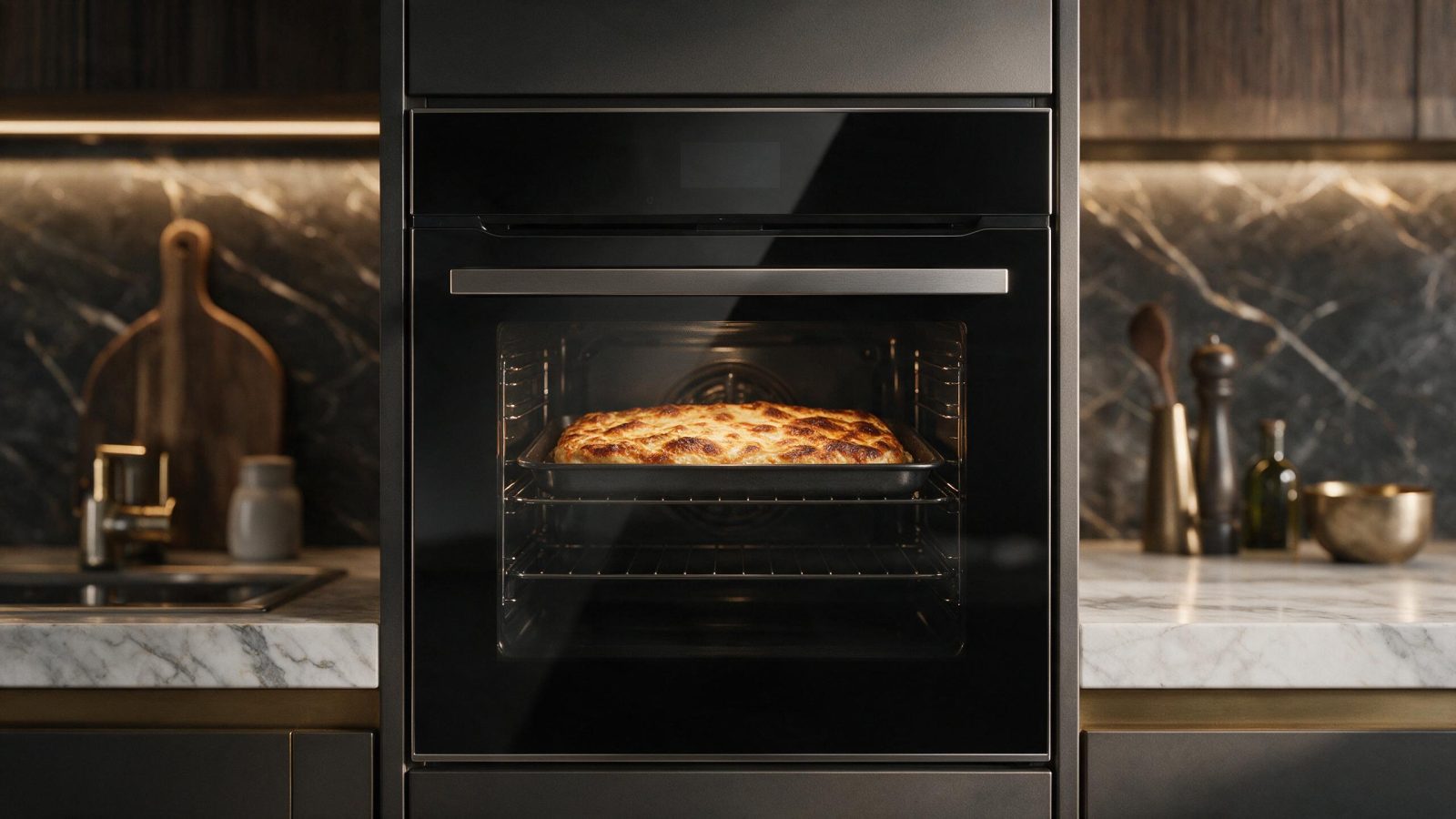
One side of a tray browning first is often a loading, rack or pan question before it is a sensor or heating question.
One side of a tray browning first is often a loading, rack or pan question before it is a sensor or heating question. Put one tray on the rack position your manual recommends for the mode, keep oversized pans from blocking airflow, and repeat the same recipe with the same pan before changing anything else.
Uneven browning does not automatically mean the oven is running hot. Rack position, pan material, convection airflow, door opening and food placement can all create a repeatable pattern before a sensor or heating component becomes the main suspect.
Use the rack position recommended for the selected mode. Center one tray and keep oversized pans or foil from blocking airflow. Compare results with the same pan and recipe before changing several variables at once. These steps are useful because they are external, reversible and give you information without turning a symptom into an unsafe DIY repair.
If the same side still browns faster, check temperature more systematically. A reliable oven thermometer can help identify a large persistent offset, but oven temperature naturally cycles above and below the setpoint. Watch the pattern over a full preheat and cooking period instead of relying on one instant reading.
A good troubleshooting note includes the exact model, what the appliance was doing when the symptom appeared, whether the condition is constant or intermittent, and any display code. Changing several settings at once makes the pattern harder to interpret, so make one safe change at a time and record the result.
The use-and-care manual for one Bertazzoni gas range with a self-clean oven describes four elements: upper bake, lower bake, broil and convection, used alone or combined for the cooking modes. Convection bake uses the upper and lower elements plus the fan, and the manual recommends it for multiple racks, naming levels 3 and 5 for two racks. It adds that preheat time depends on the temperature and the number of racks, and that a tone signals the end of preheating.
Because each mode heats differently, a result that looks like an oven fault in one mode can be normal in another. Check the manual for your model for its own recommendations.
| Symptom | What it can point to | What you can safely check |
|---|---|---|
| Tray browns on one side only | Pan or foil blocking airflow, an off-center tray or a rack position that does not suit the mode | Center one tray and use the recommended rack |
| Top browns too fast | Rack too high, oven not preheated, or the wrong bake setting | Move to the recommended rack and wait for the preheat tone |
| Bottoms burn or crust is too dark | Dark pans or the wrong mode | Try a lighter pan and the same recipe |
| Same pattern in several controlled tests | Temperature sensing, calibration, fan or heating components | Note the pattern and book diagnosis |
The purpose of these checks is not to prove which internal component has failed. It is to remove simple operating conditions and give the technician a cleaner starting point. If the symptom returns after the normal manual-approved checks, the next step should be diagnosis rather than repeated resets or improvised disassembly.
The same manual says oversized baking sheets, roasting pans and cakeware act as a baffle: leave at least 1 inch of space on all sides, remove the grill pan when it is not in use, and turn the bakeware during cooking if needed. For fan-assisted modes it advises reducing the recipe temperature by 70 F compared with conventional cooking. Its cooking troubleshooting table lists incorrect rack position, an oven that was not preheated and the wrong bake setting among causes of food browning too much on the top or bottom.
The manual for one dual fuel range also says pan type matters: light non-stick or anodized pans give golden crusts, while dark pans give crisper crusts and may need the bake temperature lowered by 25 F. Check your own manual, since the advice differs.
If a consistent imbalance remains across controlled tests, a technician may need to evaluate temperature sensing, heating components, convection fan operation, calibration and control behavior. Do not open panels or attempt live electrical measurements.
If the appliance is leaking near electricity, smells of gas or burning insulation, sparks, overheats abnormally, or repeatedly trips a breaker, stop using it. Safety symptoms take priority over completing a cycle or protecting food.
Continue with Self-Clean Cycle Finished But the Oven Door Is Still Locked? for the closest next step. Also see A Burning Smell From Your Range or Oven: What It Means to Stop Now when the symptom overlaps with that system.
Schedule service when the symptom is repeatable after the safe checks, when a model-specific error returns, or when the next diagnostic step requires internal electrical, gas, sealed-refrigeration or built-in extraction work. The service request should include the model number, the exact symptom, the checks already completed and any photo of the display that helps document the condition.
Should I keep resetting the appliance if it works for a while afterward?
No. One documented reset can clear a temporary control state, but a fault that returns should be diagnosed rather than repeatedly cleared.
Should I order a part before the technician arrives?
Usually not. Similar symptoms can come from different causes, and an unnecessary part can cost more than the time saved. Confirm the failed component first.
What should I send with the booking request?
Send the model number, a concise description of the symptom, any error code, when the issue started and the result of the safe checks above.
Should I lower the temperature in convection mode?
The manual for one Bertazzoni gas range advises reducing the recipe temperature by 70 F with fan-assisted modes compared with conventional cooking. Check the manual for your own model.
Does the oven indicator light cycling mean something is wrong?
On one dual fuel range, the orange front light is the oven thermostat light: it stays on during preheat and then cycles on and off with the thermostat. Cycling alone is normal.
Can a dark pan make one side brown faster?
The manual for one model says dark pans give crisper crusts and may need a lower bake temperature. Using the same pan each time helps you judge the oven rather than the pan.
Author: Julian Reed — Appliance Care & Technical Review
—
A burner that clicks, lights on one side or needs several tries is usually checked against cap seating, residue, moisture and how long the…
Most refrigerator sounds are worth judging by whether they are new, persistent or paired with a temperature change, not by volume alone.
A wet plastic lid after the cycle is usually a result of how little heat plastic holds, not a sign that the dishwasher has…
Share a few details and we’ll confirm an appointment. Prefer to talk? Call us and we’ll help right away.
Use the secure scheduler below to request your appointment.