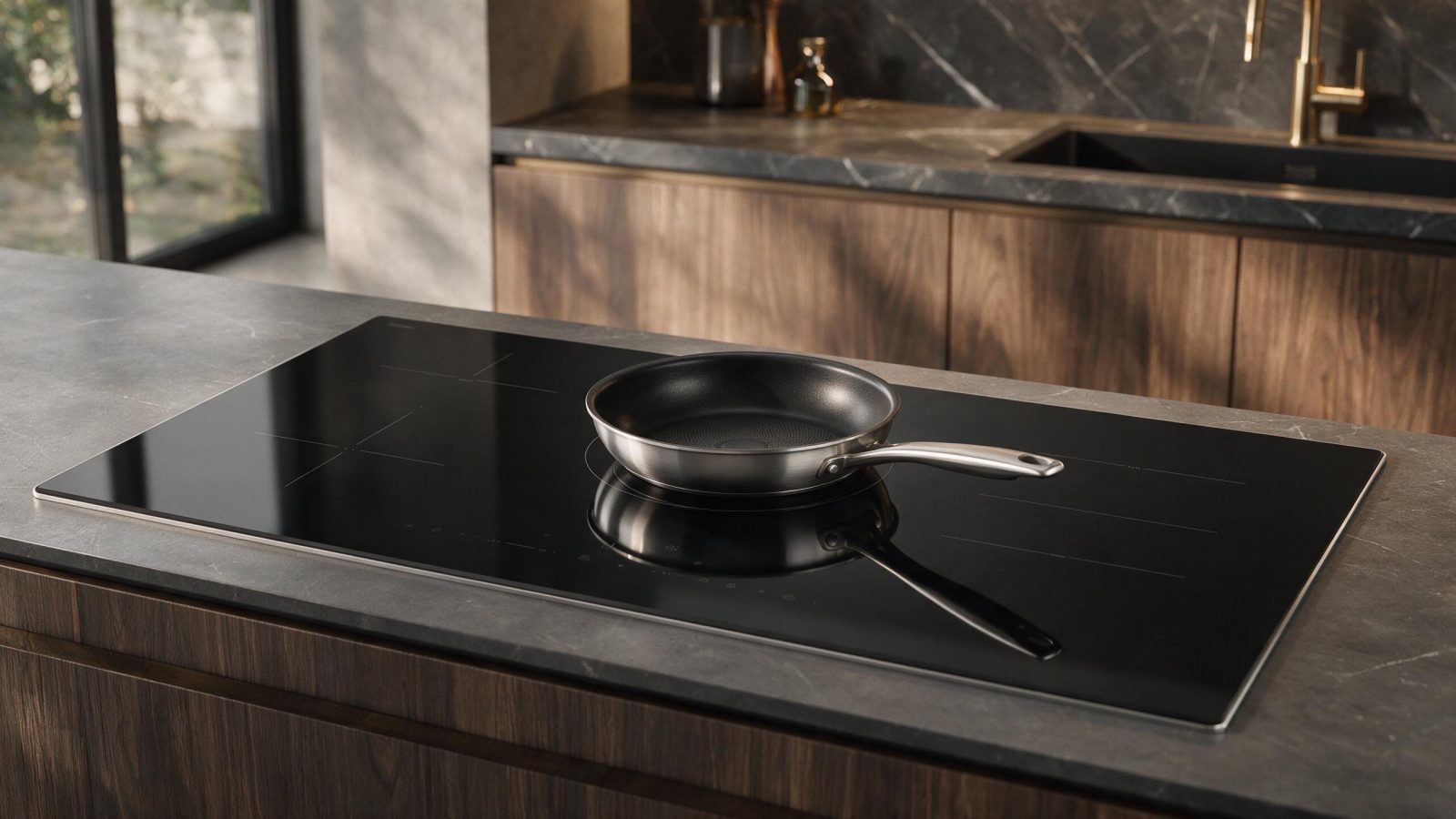
On an induction cooktop, a zone that will not heat is usually checked against the cookware and placement first, because pan detection blocks heating until a suitable pan sits correctly on the zone.
On an induction cooktop, a zone that will not heat is usually checked against the cookware and placement first, because pan detection blocks heating until a suitable pan sits correctly on the zone. Try a pan you know is magnetic and flat, compare the other zones, and note any symbol or code before assuming an electronics fault that would affect the repair estimate.
Induction repair should not begin with a costly parts assumption. Cookware compatibility, pan size, placement, control lock and a model-approved reset are inexpensive variables to eliminate before a zone-specific electronics fault is considered.
Test with more than one known-compatible pan. Compare the affected zone with the other zones. Record any code and whether the circuit breaker or gfci is involved. These steps are useful because they are external, reversible and give you information without turning a symptom into an unsafe DIY repair.
If only one zone fails with several compatible pans, the diagnosis becomes more focused. If the entire cooktop is dead or trips the circuit, the problem may involve power supply, controls or internal power electronics. Those categories carry different repair scopes and parts costs.
A good troubleshooting note includes the exact model, what the appliance was doing when the symptom appeared, whether the condition is constant or intermittent, and any display code. Changing several settings at once makes the pattern harder to interpret, so make one safe change at a time and record the result.
The installation and user manual for one Bertazzoni induction rangetop says each zone has pan detection that blocks heating until a suitable pan is correctly placed, and that a symbol appears after a few seconds if the pan is unsuitable or misplaced. Induction needs magnetic iron or steel cookware; glass, porcelain, ceramic and aluminum do not work, and a magnet that sticks to the base means the pan is suitable.
The manual also says pans should be flat-bottomed and centered. A concave or convex base leaves an air gap that can overheat the glass and inductors. The Bertazzoni US FAQ likewise says induction cookware must be flat and magnetic, and that aluminum or copper alone will not work.
| Symptom | What it can point to | What you can safely check |
|---|---|---|
| Pan symbol appears on a zone | Unsuitable or off-center cookware | Try a pan that a magnet sticks to, centered on the zone |
| Only one zone fails with several suitable pans | A zone-specific problem, which is a narrower and different repair scope | Compare with the other zones and note which one |
| Whole cooktop dead or trips the circuit | Power supply, controls or internal power electronics | Check the breaker once and record any code; do not keep resetting |
| Humming or a fan after you turn it off | Often normal operation, according to the manual for one model | Compare with a normal day and a different pan |
The purpose of these checks is not to prove which internal component has failed. It is to remove simple operating conditions and give the technician a cleaner starting point. If the symptom returns after the normal manual-approved checks, the next step should be diagnosis rather than repeated resets or improvised disassembly.
The same manual says humming during operation is normal and varies with the cookware, and that a fan can be heard running after the cooktop is turned off. It describes a Power mode that runs a zone at maximum for up to 10 minutes and then drops to 9, and a Holding mode that keeps pan bottoms near 160 F (70 C) for up to 2 hours. A residual-heat H clears once the glass cools below about 140 F (60 C).
A child-lock function also exists, activated by turning the zone 1 and 2 knobs left together until an L appears. A zone that seems unresponsive after cleaning may simply be locked, which is worth ruling out before cost comes into the discussion.
Do not open an induction cooktop to test live components. High-voltage electronics can remain dangerous even when the surface looks cool. The right cost estimate follows safe electrical diagnosis.
If the appliance is leaking near electricity, smells of gas or burning insulation, sparks, overheats abnormally, or repeatedly trips a breaker, stop using it. Safety symptoms take priority over completing a cycle or protecting food.
Continue with Induction Cooktop Won’t Recognize a Pan? Check the Cookware First for the closest next step. Also see Electrical Warning Signs Every Kitchen Should Take Seriously when the symptom overlaps with that system.
Schedule service when the symptom is repeatable after the safe checks, when a model-specific error returns, or when the next diagnostic step requires internal electrical, gas, sealed-refrigeration or built-in extraction work. The service request should include the model number, the exact symptom, the checks already completed and any photo of the display that helps document the condition.
Should I keep resetting the appliance if it works for a while afterward?
No. One documented reset can clear a temporary control state, but a fault that returns should be diagnosed rather than repeatedly cleared.
Should I order a part before the technician arrives?
Usually not. Similar symptoms can come from different causes, and an unnecessary part can cost more than the time saved. Confirm the failed component first.
What should I send with the booking request?
Send the model number, a concise description of the symptom, any error code, when the issue started and the result of the safe checks above.
Does humming mean the cooktop needs repair?
Not by itself. The manual for one Bertazzoni induction rangetop calls humming normal and says it varies by cookware. A new, loud or changing sound alongside poor heating is more useful to report.
How do I know whether my pan is suitable?
The manual says a magnet that sticks to the base means the pan is suitable, and that the base should be flat and centered on the zone. Glass, ceramic and aluminum cookware will not work on its own.
Why did the zone drop its power while cooking?
On the manual for one model, Power mode runs a zone at maximum for up to 10 minutes and then lowers it. That is a designed behavior, not a failure, so check your own manual before treating it as one.
Author: Julian Reed — Appliance Care & Technical Review
—
An oven repair costs what the cause requires, and the same complaint, such as not heating or heating unevenly, can come from very different…
A wine cooler repair estimate depends on what the diagnosis finds, and the most useful thing you can bring is actual temperature data for…
Range repair cost depends on the exact model, what diagnosis finds, how easy the appliance is to reach and which part, if any, has…
Share a few details and we’ll confirm an appointment. Prefer to talk? Call us and we’ll help right away.
Use the secure scheduler below to request your appointment.